
Let us come to an agreement between us and you: that we will worship none but Allah/Sunnatullah, associate none with Him/Sunnatullah, nor take one another as lords instead of Him. If they turn away, say, ´Bear witness that we are Muslims´ (3:64)


Let us come to an agreement between us and you: that we will worship none but Allah/Sunnatullah, associate none with Him/Sunnatullah, nor take one another as lords instead of Him. If they turn away, say, ´Bear witness that we are Muslims´ (3:64)
Intentional Community - Pelihara Diri & Keluarga
 Dan ketika Nabi Musa memohon supaya diberi air untuk kaumnya, maka Kami berfirman: “Pukullah batu itu dengan tongkatmu”, lalu terpancutlah dari batu itu DUA BELAS MATA AIR (satu komuniti mempunyai 12 orang); sesungguhnya tiap-tiap satu puak telah mengetahui tempat minumnya masing-masing. (Dan Kami berfirman): “Makanlah dan minumlah kamu dari rezeki Allah itu, serta janganlah kamu bertebaran di muka bumi ini dengan melakukan kerosakan”.(2:60)

 Kami wahyukan kepada Musa serta saudaranya “Hendaklah kamu berdua mendirikan rumah-rumah di Mesir untuk menempatkan kaum kamu, .dan jadikanlah rumah-rumah kamu tempat sembahyang, serta dirikanlah sembahyang di dalamnya, dan sampaikanlah berita gembira kepada orang-orang yang beriman (bahawa mereka akan diselamatkan dari kezaliman Firaun dan kaumnya)”. (10:87)


 Read the Fatwa


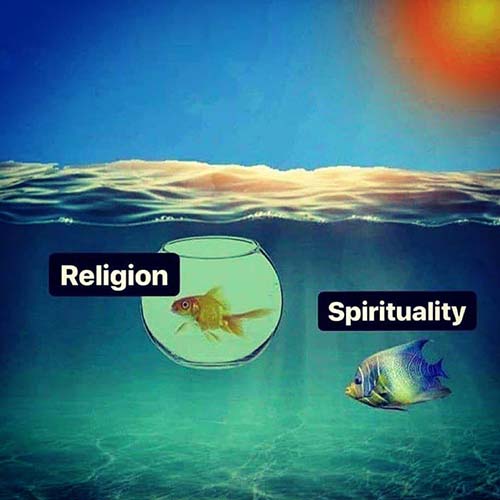
| No. | Spiritual | Religion |
|---|---|---|
| 1. | Science/spiritual laws based | Faith based |
| 2. | Spirituality is doing what is right, regardless of what you are told | Religion is doing what you are told, regardless of what is right |
| 3. | Spirituality invites you to reason it all, to question it all and to decide your actions and assume the consequences | Religion has a dogmatic and unquestionable assembly of rules that need to be followed without question |
| 4. | Truth discovery | Truth knowledge |
| 5. | Experience based | Belief system |
| 6. | Non-doctrine oriented | "Good/evil" doctrine |
| 7. | Authentic self | Conditioned self |
| 8. | Spirituality is based on freedom | Religion is based on fear |
| 9. | Joyous living | Narrow creeds |
| 10. | Personal belief/value system | Dictated beliefs/conditioned minds |
| 11. | Practice of behavior | Practice of worship |
| 12. | Spiritual practices such as meditating, listening to music, and hiking | Religious practices such as prayer, reading the Quran/Bible/Torah, and rituals |
| 13. | It is part of each person that searches for finding the answers to life's essential questions about purpose, meaning, worth and wonder, often in quest of an ultimate value or the holy | It is typically experienced within a social institution with commonly shared traditions, sacred texts, beliefs, and worship practices. Religious institutions usually have a governing structure with designated leaders |
| 14. | Spiritual development | Worship |
| 15. | Self-directed | Authority-directed |
| 16. | People's inherent goodness | People's inherent sinfulness |
| 17. | Present oriented: Heaven is a state of mind | Future oriented: Heaven is a place you go with you die |
| 18. | Inside God | Outside God |
| 19. | Internal divinity | External divinity |
| 20. | Belief that the divine is within us all | Belief in superhuman power outside of you, the creator of the universe |
| 21. | Individualistic focused | Community focused |
| 22. | The emphasis is on the individual | The emphasis is on the institution |
| 23. | Human relationships | Brick/mortar temple |
| 24. | Less formal, unorthodox | Formal, orthodox organized |
| 25. | Modernized | Traditional |
| 26. | Inclusive | Exclusive |
| 27. | Formless | Structured |
| 28. | Spirituality is for those who have already been in hell | Religion is for people who are afraid of going to hell |


